
What’s Changing Parents’ Expectations From Schools
April 15, 2026
Parent expectations are not static. They are shaped continuously by the experiences parents have everywhere else - and right now, several converging shifts are raising the bar for what it feels like to be a parent at a school. Understanding these shifts is increasingly relevant for school leaders thinking seriously about institutional positioning.
1. The Consumer Experience Has Become the Reference Point
The most significant shift is also the most structural. Parents now manage most of their lives through platforms that have invested heavily in removing friction - banking apps that confirm transactions instantly, healthcare portals that surface records without a phone call, travel platforms that consolidate everything in one place. These experiences have quietly set a new baseline for what “organised” feels like. Schools are not being compared to other schools. They are being compared to every well-run service a parent interacts with.
2. Clarity Has Replaced Comprehensiveness as the Standard
There was a time when thoroughness signalled quality - detailed handbooks, exhaustive communications, layered processes. Today, parents read that as complexity. What they respond to now is clarity: knowing exactly what is expected, when, and through which channel. The schools that feel easiest to be a parent at are not necessarily the ones communicating most - they are the ones communicating most clearly. The distinction is significant, and it has real implications for how schools design their parent-facing systems.
3. Friction Tolerance Has Fallen Sharply
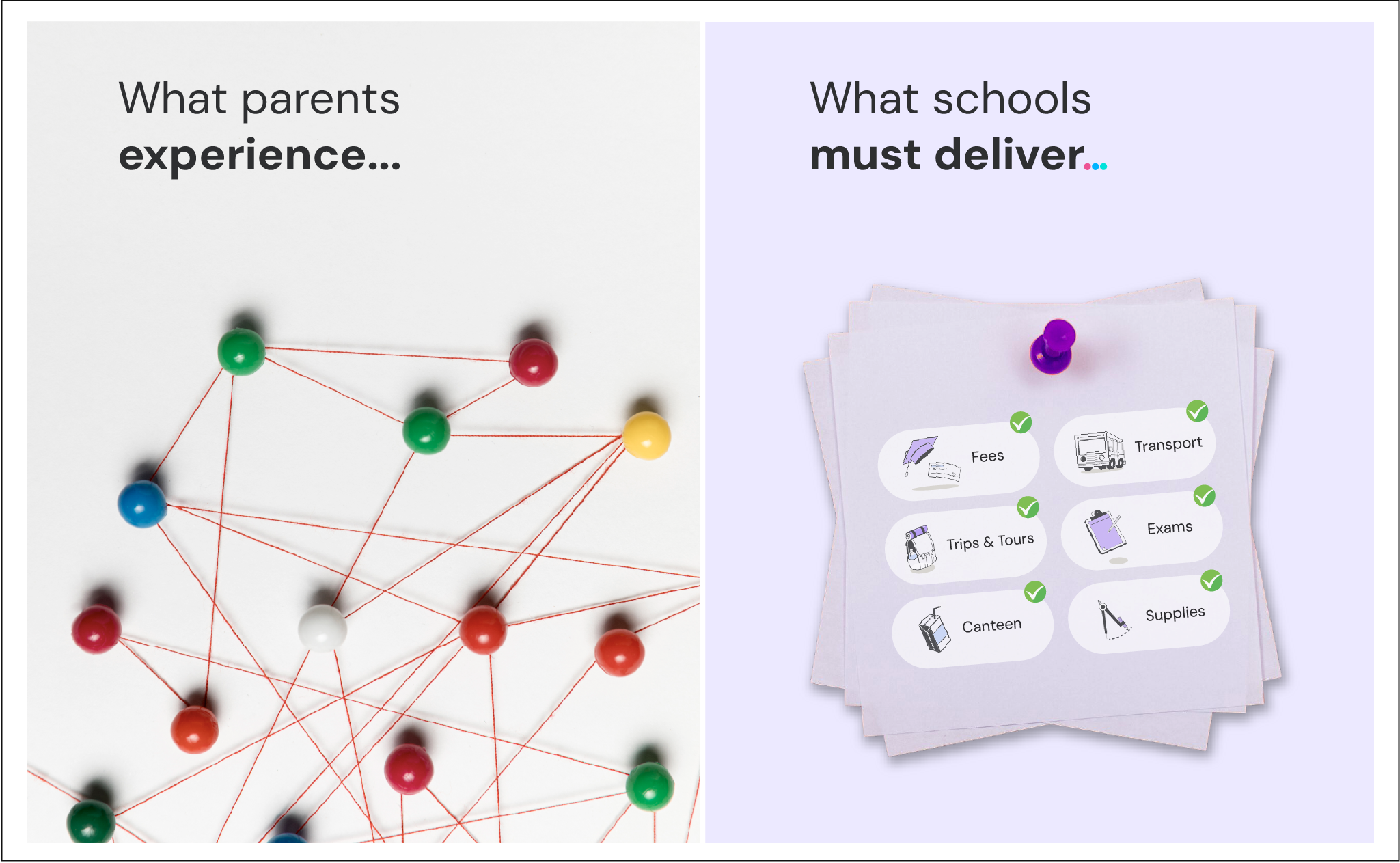
What parents were once willing to absorb as a normal part of school life multiple portals, repeated form submissions, unclear payment processes, inconsistent communication channels - now registers as a signal about institutional quality. This is not impatience. It is recalibration. When every other service in a parent’s life has reduced the effort required, effortful school interactions stand out more than they used to. The friction itself has not changed; the tolerance for it has.
4. Trust Is Now Built Through Consistency, Not Just Communication
Parents have always valued responsiveness. What’s shifted is how trust is built between interactions. Increasingly, it is built through consistency - whether processes work the same way every time, whether information arrives when expected, whether the experience of being a parent at the school feels predictable. Inconsistency, even when minor, creates cognitive load. And cognitive load, accumulated over a school year, quietly shapes how parents talk about the institution to others.
5. Perception Is Formed Long Before Feedback Is Given
Perhaps the most consequential shift for school leaders is this: parents form their impressions of a school’s operational quality well before those impressions surface in any formal channel. By the time a concern reaches leadership, it has usually already been discussed in parent networks. The feedback loop that most schools rely on — surveys, parent-teacher meetings, formal complaints — captures sentiment late. The schools managing this well are the ones investing in the experience itself, rather than waiting for the signal.
Taken together, these shifts point in one direction: parent experience is no longer a soft consideration sitting alongside academic quality. It is becoming part of how institutional reputation is built, sustained, and lost.
Related Articles

Parenting isn’t easy, earning rewards should be !